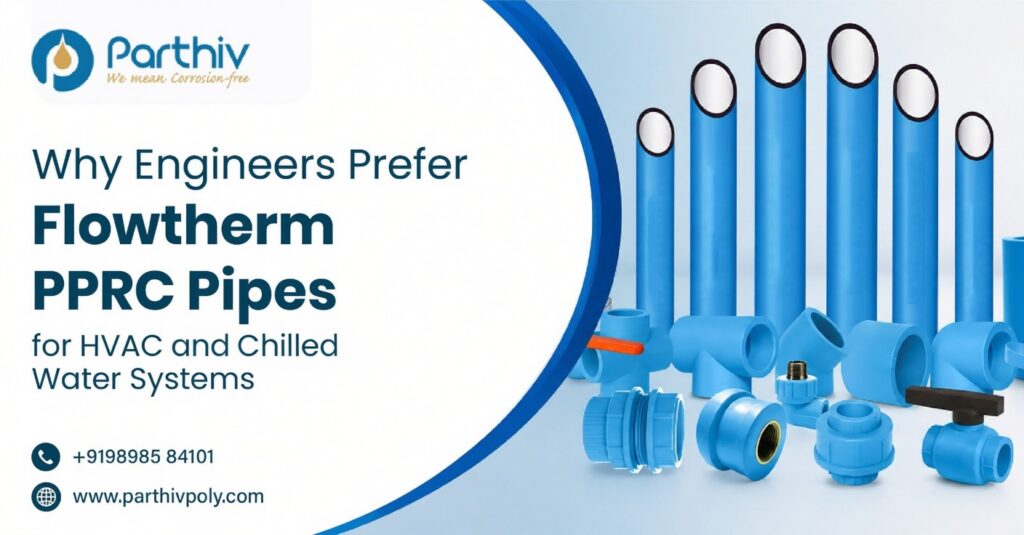
Selecting pipes for HVAC or chilled water systems might appear simple, yet there are long-term implications of any wrong selection decision, such as corrosion, pressure loss, difficulties of maintenance, and high costs. And that is the reason why Flowtherm PPRC Pipes deserve attention.
Being corrosion-resistant, having low thermal conductivity, a lightweight design, and heat-fused joints, it becomes a perfect piping solution that matches the needs of modern HVAC water systems.
Should you want reliable water flow, easy installation, and minimal corrosion risks, getting acquainted with PPRC properties will help you make a better project choice.
Reasons Why Engineers Choose Flowtherm PPRC Pipes for HVAC Systems
Since HVAC and chilled water systems usually run for long periods, the piping should be able to withstand temperature changes without additional maintenance challenges.
The following properties of PPRC can be useful:
- Does not rust like conventional metal pipes.
- Smooth internal surface allows efficient water flow.
- Has low thermal conductivity.
- Lightweight design makes installation easier on site.
- Heat-fusion allows the formation of strong, homogeneous joints.
All of this lets engineers build more efficient and reliable water distribution systems. However, correct system design is important.
Corrosion Resistance Provides Reliable Water Flow
Corrosion can slowly affect the metallic pipe. As a result, deposits may gather inside the pipe and block the flow path. Therefore, the pressure losses may grow.
PPRC does not suffer from galvanic corrosion like metal pipes. Therefore, its internal surface can remain smooth during the entire service period. This feature lets you maintain reliable flow, which is crucial for HVAC system operation.
Additionally, corrosion resistance can help to avoid extra maintenance challenges related to rust and scaling.
Low Thermal Conductivity Improves HVAC Performance
Chilled water should pass through the piping network with minimal heat loss. Fortunately, the material of the PP-R pipe has low thermal conductivity compared with metal.
This property makes Flowtherm PPRC Pipes a good choice for temperature-controlled water systems. However, pipe alone cannot serve as a replacement for proper insulation.
Engineers should select appropriate insulation based on:
- Chilled water temperature.
- Temperature and humidity of the ambient environment.
- Possible condensation.
- Building requirements.
- Project-specific energy standards.
Therefore, correct insulation and piping should form one system.
Easier Installation without Conventional Welding of Metals
PPRC pipes are lightweight, so their transportation and positioning become easier. Moreover, the installation of PPRC pipes is done via heat-fusion rather than welding of metals.
Heat-fusion makes a homogeneous joint of two compatible pipes and fittings. However, heat-fusion should be done properly, considering the right heating time and process. Engineers should take into account pipe supports, pressure testing, thermal expansion, and operating conditions.
Pipes Built for Modern Chilled Water Projects
In the end, HVAC piping should provide more than just water transfer. It should ensure reliable flow, easy installation, corrosion resistance, and performance.
These properties make PPRC a good choice for many modern HVAC and chilled water systems.
For project-specific requirements for pipes, contact Parthiv Poly. Learn about appropriate sizes, fittings, pressure classes, and system requirements for your HVAC piping.
FAQs:
1) Are PPRC pipes suitable for chilled water systems?
Yes, PPRC piping systems are widely used for chilled water and air-conditioning projects due to their corrosion resistance and low thermal conductivity.
2) Do PPRC pipes need to be insulated?
Yes, insulation should be applied to chilled water systems to control heat gains and condensation. The right insulation depends on operating and ambient conditions.
3) Why do engineers prefer PPRC pipes?
Because of corrosion resistance, smooth internal surfaces, lightweight design, low thermal conductivity, and reliable heat-fused joints.